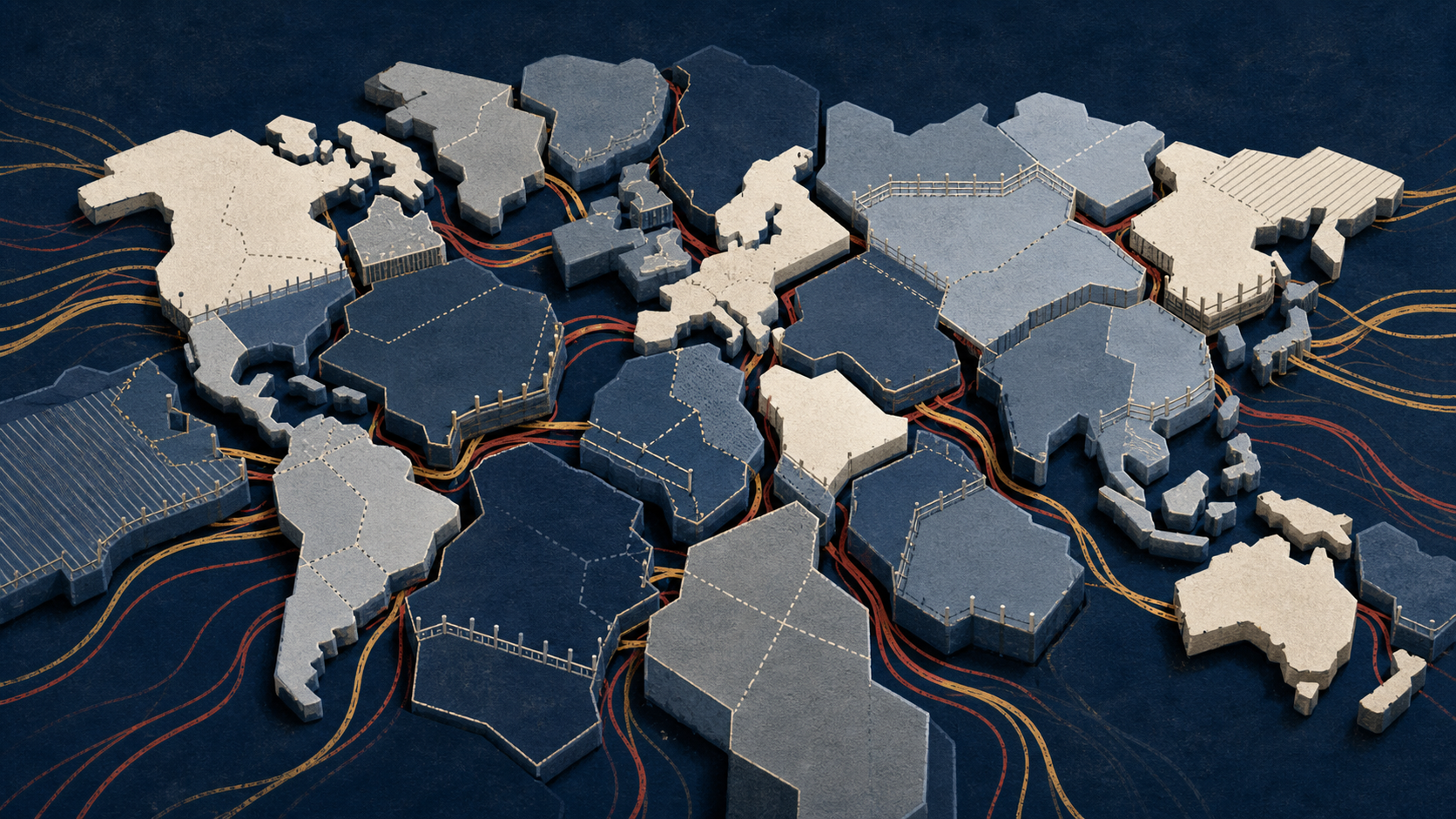
The instinct, when betting and crime get discussed together, is to look for the weak regulator — the jurisdiction that is not trying hard enough. A 2026 analysis from the Global Initiative Against Transnational Organized Crime, pointedly titled "Betting on impunity," makes a more uncomfortable argument: the risk lives less in any single lax market than in the gaps between the markets. What one country bans, another licenses. What one regulator can see, another cannot. And the largest betting event in history — the 2026 World Cup, with global wagering forecast above $50 billion — is precisely the kind of event that flows through every one of those seams at once.
Arbitrage as the core mechanism
The thesis is structural. Illegal betting has long served as a conduit for three things at once — money laundering, competition manipulation, and the exploitation of differences between national regulatory frameworks. That third item is the engine. Because activities prohibited in one jurisdiction may be legal in another, an operator can incorporate where the rules are most permissive, license where oversight is lightest, and still reach customers in countries that would never have granted it a permit. The internet erases the distance; the legal patchwork supplies the loophole. The result the report names is impunity: not that no one is responsible, but that responsibility falls through the cracks between everyone.
This reframes what "the offshore problem" actually is. For a country like the Philippines, the temptation is to think of offshore betting as a domestic enforcement failure — sites that should be blocked, payments that should be intercepted. The arbitrage lens says the deeper issue is that the offshore operator is, somewhere, perfectly legal, which is exactly why it is so hard to reach. The Philippines rebuilt its anti-money-laundering regime to climb off the FATF grey list and can police what happens inside its own perimeter. What it cannot do is legislate away the permissive jurisdiction on the other end of the connection. That asymmetry — strong control over the inside, near-zero leverage over the outside — is the arbitrage risk in one sentence.
Impunity is not that no one is responsible. It is that responsibility falls through the cracks between everyone.
On what the regulatory-arbitrage thesis actually describesPrediction markets: the newest gap
If arbitrage is the mechanism, prediction markets are the report's prime exhibit of where it is widening fastest. These platforms — where users trade on the outcome of events rather than placing a traditional bet — have spread rapidly across jurisdictions, and many operate without local gambling or financial-services licences at all. Their legal status is genuinely fragmented: in some places they are regulated financial instruments, in others gambling, in others nothing in particular. That ambiguity is the opening. Existing enforcement tools were built to supervise either bookmakers or securities markets, and a prediction market can position itself as neither.
The crypto layer deepens the problem. On crypto-based prediction platforms, settlement can run through stablecoin-to-fiat conversion channels that fall outside both betting oversight and virtual-asset regulation — a payment path that two different rulebooks each assume the other is watching. Add anonymous or pseudonymous accounts and customers trading from countries with no connection to the event, and you have a market that is, by design, harder to monitor than a licensed bookmaker. Prediction markets are restricted or banned in more than 50 countries, and yet they continue to grow, which is itself a demonstration of arbitrage: a ban in one place is not a ban everywhere, and online it may not be much of a ban at all.
When the governing body joins the frontier
The detail that gives the report its edge is that the frontier is no longer fringe. In April 2026, FIFA announced a partnership naming ADI Predictstreet — a Gibraltar-licensed platform linked to an Abu Dhabi investment group — as the official prediction-market platform of the World Cup, in a deal reported at around $150 million. FIFA was careful to note the arrangement includes a comprehensive integrity-monitoring framework, with tracking of suspicious trading and structured information-sharing between the parties. Taken at face value, that is a responsible posture. But it also means the sport's own governing body has placed a prediction-market operator alongside its established global sponsors, lending the format a legitimacy it did not have a tournament ago — even as the same format sits, in much of the world, in exactly the licensing limbo the report warns about.
This is the same tension we examined when FIFA's broader commercial embrace of betting drew first-of-its-kind concern from integrity specialists, and it connects directly to the manipulation risk tracked through the integrity-monitoring systems watching the tournament. Sportradar detected 1,116 suspicious matches worldwide in 2025, with football the most affected — and monitoring, however good, only sees the regulated markets that share data with it. The prediction-market and offshore activity flowing through the arbitrage gaps is the part the net is structurally weakest at catching.
The Philippine reading
For the Philippines, the arbitrage thesis is clarifying rather than comforting. The country's regulatory response — the licensed perimeter, the payment crackdown, the site-blocking, the comprehensive iGaming framework now being drafted — is essentially an effort to make the inside of the perimeter as clean and accountable as possible. That is the right work, and it is the only work a single country can actually do. What the Global Initiative report adds is the sober reminder that the perimeter has an outside, and the outside is governed by other people's rulebooks. A Filipino can be fully protected by PAGCOR's regime right up until the moment they click an offshore link, and no amount of domestic rule-making changes the legality of the platform on the other side.
Which is why the practical conclusion is the same one that runs through all of this coverage, only now with a clearer rationale behind it. Staying inside the licensed market is not merely about avoiding scams; it is about staying inside the one jurisdiction whose rules are actually written to protect you. Step outside it, and you are not in a worse-regulated market — you are in the gap between markets, which is the place the report names impunity.
The bottom line
"Betting on impunity" makes an argument worth sitting with: the World Cup's gambling risk is a property of the global system's seams, not of any one regulator's failure. Prediction markets are the fastest-widening of those seams, crypto settlement makes them harder to watch, and FIFA's own deal-making shows how quickly yesterday's grey zone becomes today's official sponsor. The Philippines can build a clean perimeter and is doing so. It cannot close the gaps between its rulebook and everyone else's. For the individual bettor, that hands down a single, durable instruction for the tournament and well beyond it: stay where the rules bind, because the impunity the report describes begins exactly where they stop.
Frequently Asked Questions
Sources
- Global Initiative Against Transnational Organized Crime, "Betting on impunity: How the World Cup will heighten risks in global gambling systems" (2026)
- iGaming Business, "Global law enforcement fortifies defense against illegal betting for World Cup 2026"
- Sportradar Integrity Services, 2025 suspicious-match monitoring data
- PH Gaming Intel, "A $50 Billion Tournament: How FIFA's Own Embrace of Betting Raises the Stakes for Filipino Fans"
- PH Gaming Intel, "The Integrity Net Around the 2026 World Cup — and the Offshore Gap It Cannot Cover"
- PH Gaming Intel, "The Grey List Risk Behind the World Cup Betting Surge"