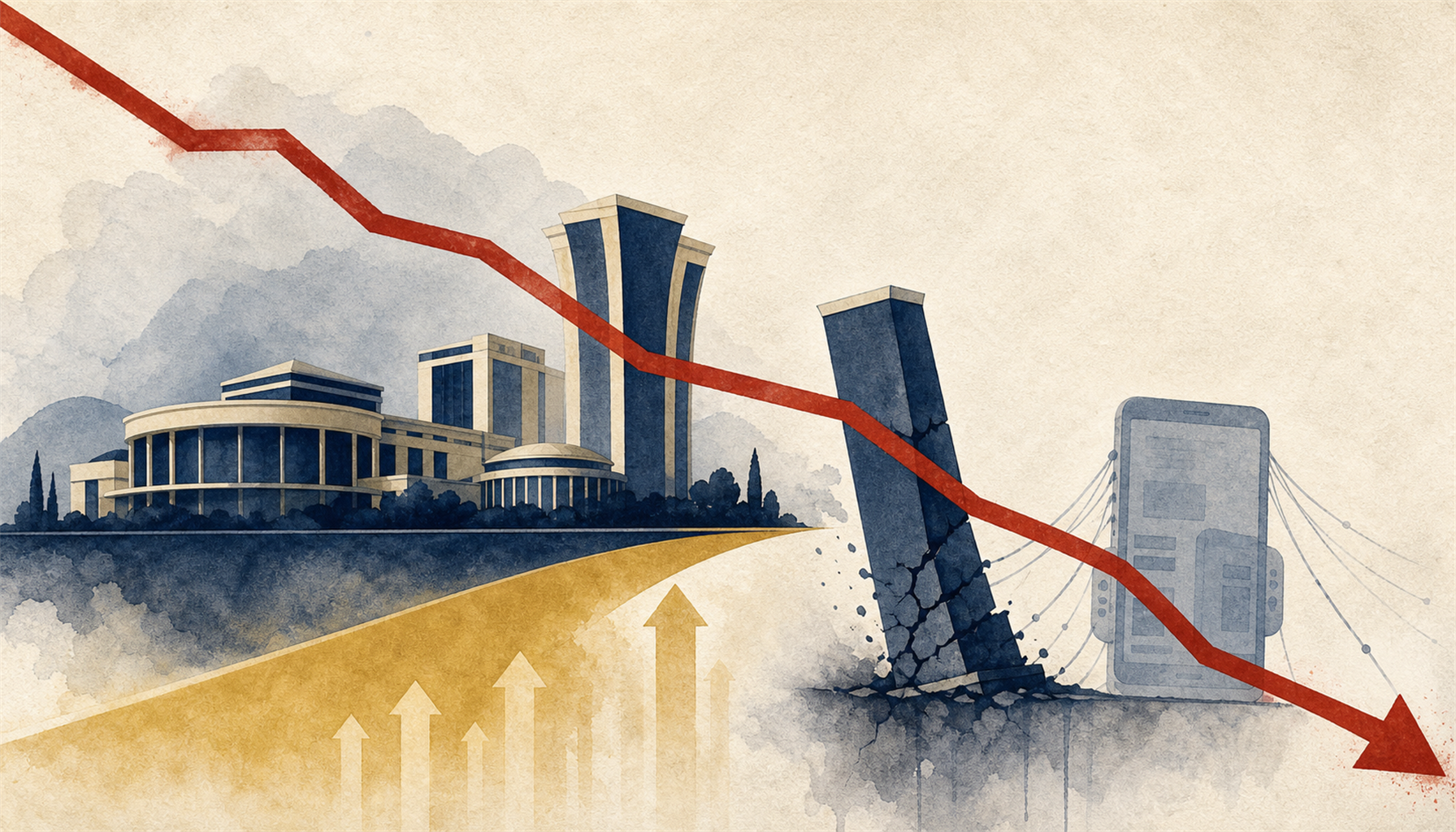
For most of the past year, the Philippine gaming regulator has been managing a slow squeeze of its own design — capping rebates, delinking e-wallets, blocking sites, weighing ad bans. In early June 2026, the cumulative effect showed up in the one number the market watches most. Alejandro Tengco, chairman and chief executive of the Philippine Amusement and Gaming Corporation (PAGCOR), told reporters that industry-wide gross gaming revenue could fall by as much as 19% this year — to somewhere between PHP 320 billion and PHP 350 billion, down from the PHP 396.14 billion the sector posted in 2025.
The headline is the size of the drop. The story underneath it is the reversal: as recently as February 2026, PAGCOR had been projecting roughly flat revenue for the year. A 19% downgrade in four months is not a rounding adjustment — it is the regulator conceding that the online slowdown is deeper and stickier than its earlier read assumed.
What changed between February and June
In February, PAGCOR's caution was framed mostly around tourism: a stagnant visitor recovery would keep the land-based business flat rather than growing. That was a story about the ceiling, not the floor. By June, the conversation had moved to the floor — and the floor is online.
The first-quarter numbers are what forced the rethink. Overall GGR fell 15.87% year on year to PHP 87.6 billion, but the electronic-gaming segment fell harder, down 22.43% to PHP 39.9 billion. That is the cleanest read yet of what the August 2025 e-wallet delinking order actually did to the online business once a full comparison quarter had passed. When the most convenient way to fund an online account is removed, some players stop, some move to slower rails, and some leave for channels that still accept the easy money. All three show up as a smaller regulated top line.
Tengco added a second factor that was not on the February list: cost pressures he tied to geopolitical tensions in the Middle East, which weigh on consumer spending and on the operating environment. Whatever weight one gives that macro overlay, it lands on top of a domestic policy mix that was already pulling revenue down on purpose.
A 19% downgrade in four months is not a rounding adjustment. It is the regulator conceding the online slowdown is deeper than its own earlier read.
On the gap between February's flat projection and June's forecastA two-speed industry
The forecast is not a story of uniform decline. PAGCOR was explicit that the two halves of the industry are moving in opposite directions. Online and VIP play are contracting; land-based integrated resorts may hold up, supported by an upswing in visitor arrivals that brings customers onto casino floors regardless of e-wallet rules. Tourism-fed, cash-and-card land-based gaming simply does not depend on the funding rail that the delinking order severed.
That divergence matters for how to interpret the number. A 19% industry decline driven by an online segment under deliberate regulatory pressure is a very different signal than a 19% decline spread evenly across a market losing customers it wants to keep. The land-based cushion is the tell that this is, in large part, a managed contraction rather than a market in distress. It also explains why operators with diversified or offshore exposure — DigiPlus among them, through its international hedge — have been repositioning rather than simply waiting for the home market to recover.
Is a falling number good news or bad news?
This is where the GGR figure has to be read carefully, because it can be made to argue either side of the live policy debate. To the camp pushing a total online ban, a 19% drop is evidence the activity is overheated and worth shrinking further. To operators, it is evidence the screws have been turned too far, too fast. Both can point at the same number.
The more useful framing is that much of the decline is the policy working as written. The payment friction, the cashback cap, the e-wallet delinking — these were designed to make online gambling harder to fund and to lift the most vulnerable players out of the easiest funnels. A lower regulated top line is the expected, even intended, consequence of that. The honest caveat is the one this publication has returned to repeatedly: PAGCOR's GGR counts only the licensed market. It cannot measure the volume that left for offshore sites and informal channels rather than disappearing. A falling official number is unambiguously good if the lost activity stopped; it is more complicated if a meaningful share simply moved somewhere the regulator can no longer see it.
The World Cup overlay
The forecast also arrives in the middle of the 2026 World Cup, the single largest betting trigger of the year. In an ordinary cycle a tournament of this scale would be a tailwind for sports-betting revenue. But the licensed Philippine market sits behind exactly the payment and advertising friction that is suppressing the rest of the online business, while offshore operators face no such constraints during the same peak-demand window. So the tournament is unlikely to rescue the annual number — and to the extent it lifts wagering at all, an unknown portion of that lift accrues to the unlicensed market the GGR forecast does not count. The result is a year in which the biggest betting event in history coincides with the regulator forecasting its steepest revenue decline in recent memory.
The bottom line
PAGCOR's downgrade to a possible 19% GGR fall — to PHP 320–350 billion — is the clearest official acknowledgment yet that the tightening of the past year has reshaped the market, not just trimmed it. The pain is concentrated online, traces largely to the e-wallet delinking order, and is partly cushioned by a tourism-supported land-based segment. Read in isolation, a shrinking number looks like bad news. Read against the policy that produced it, it looks more like the intended outcome — with one persistent asterisk: the official figure measures only the market the regulator controls, and the real test of the strategy is what happened to the volume that left it.
Frequently Asked Questions
Sources
- BusinessWorld, "Philippine gaming industry's revenues seen to drop 19% this year" (June 4, 2026)
- Inside Asian Gaming, "PAGCOR chair Tengco warns Philippines GGR could fall by up to 19% this year due to cost pressures from Middle East conflict" (June 5, 2026)
- Yogonet International, "PAGCOR forecasts lower Philippine gaming revenue in 2026 amid online slowdown" (June 9, 2026)
- GGRAsia, "Pagcor chief says Philippine GGR could fall by as much as 19pct this year"
- BusinessWorld, "PAGCOR projecting flat GGR on caution over stagnant tourism" (February 11, 2026)
- PH Gaming Intel, "The E-Wallet Delinking Order, Six Months On"