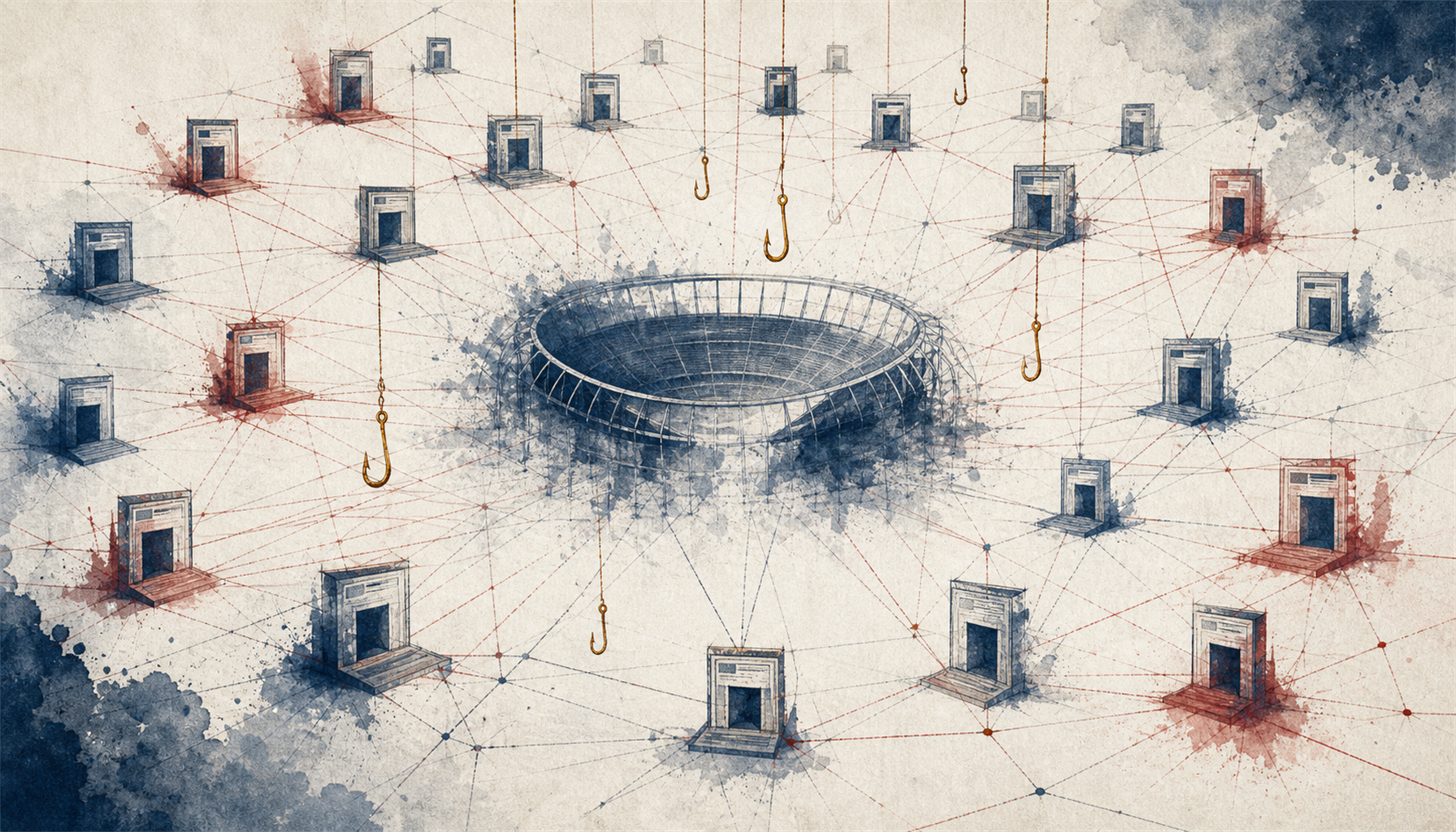
Days before the first ball is kicked, the 2026 World Cup already has a shadow tournament running alongside it — a fraud economy built specifically to harvest the attention, money, and identities of football fans. Security researchers at Group-IB mapped more than 4,300 fake domains impersonating FIFA, spread across six distinct fraud schemes operated by four separate threat-actor groups. The FBI's Internet Crime Complaint Center has issued a public warning about spoofed FIFA websites. This is not a forecast of scams to come. The scams are live now, and Filipino fans sit squarely in the blast radius.
GHOST STADIUM: a pixel-perfect fake FIFA
At the center of the campaign is a Chinese-speaking threat actor that Group-IB has named GHOST STADIUM. It built and operated more than 300 phishing domains hosting a clone of FIFA's official website so faithful that researchers describe it as pixel-perfect — down to a replicated single sign-on authentication flow and support for 11 languages. The point of a clone this good is simple: a fan who lands on it through a search ad or a forwarded link sees the real FIFA, types in real credentials, and hands them straight to the operator. That is how more than 2,500 valid FIFA account credential pairs ended up circulating for sale on dark-web markets, fed by mass infostealer-malware campaigns.
GHOST STADIUM is only the most polished node. Around it, Group-IB catalogued counterfeit merchandise shops, bogus streaming sites that charge a subscription fee and then install malware handing remote control to the attacker, and — most relevant to this audience — fake betting sites engineered to collect passport scans and selfies under the guise of identity verification, feeding straight into identity theft.
How the fake betting sites take your money — and your identity
A fake World Cup betting site attacks on two fronts. The first is the classic advance-fee trap: you deposit, the site shows you a healthy balance or a string of wins, and then the withdrawal never comes. To release "your" winnings, you are told to pay a tax, a processing fee, or a verification charge first. You pay; the money and the operator both vanish. We have written before about how PAGCOR voids winnings on unauthorized sites entirely — meaning even a real payout from an illegal site can be legally worthless.
The second front is quieter and more damaging. Many of these sites front-load a fake "KYC" step that asks you to upload a photo of your passport or ID and a selfie. On a licensed operator this is genuine regulatory identity verification. On a scam site it is the entire point: your documents are now raw material for opening financial accounts in your name or for resale. The cruel irony is that the same verification ritual that signals legitimacy on a real platform is the harvesting mechanism on a fake one. The difference is not the form. It is whether the operator behind it is licensed.
The fake betting site doesn't always want your deposit. Sometimes it wants the passport scan you uploaded to prove you were old enough to make it.
On the dual nature of World Cup betting fraudWhy the Philippine timing makes it worse
Two structural factors put Filipino fans at elevated risk. The first is the clock. Because the tournament is hosted across the United States, Mexico, and Canada, kickoff times land in the dead of night in Manila — the opening match starts around 3:00 AM Philippine time. Fans hunting for a way to watch at odd hours are pushed toward unofficial streams and downloadable apps, which is precisely the vector the malware operators exploit: a "free stream" that asks for a small subscription or an app install, then drops a remote-access trojan on the device.
The second is recourse, or the lack of it. The Philippine licensed market has rules, a regulator, and a complaints process. An offshore scam site has none of those and sits beyond any Philippine legal remedy. This is the same hard truth running through our illegal-site detection guide: once your money crosses to an unlicensed offshore operator, the realistic chance of getting it back is close to zero. The licensed perimeter is not just safer in the abstract — it is the only place where losing money to fraud comes with anywhere to turn.
The local enforcement backdrop
This global fraud wave is breaking against a Philippine market where the regulator is already mid-crackdown. PAGCOR has reported blocking roughly 93.8 percent of the 13,399 illegal gambling sites it has flagged, using an AI detection tool and coordinating takedowns with the National Telecommunications Commission and the Cybercrime Investigation and Coordination Center. The World Cup is exactly the surge event that blocking effort was built for. But site-blocking is a deterrent, not a wall — blocked domains reappear, and the GHOST STADIUM playbook of hundreds of rotating lookalike domains is designed to outrun any blocklist. The enforcement reduces exposure; it does not remove the need for personal vigilance.
It is also worth remembering that the people building this infrastructure are not always far away. The Philippines' own post-POGO scam economy — salvaged text-blaster hardware, displaced technical labor, regional scam hubs — is part of the same ecosystem that spins up fraud capacity around high-traffic events. A World Cup is a demand spike that this supply is ready to meet.
How to protect yourself
The defensive rules are unglamorous and they work:
For betting: Use only operators you can verify against PAGCOR's published licensee list. Treat as red flags any pressure to deposit quickly, payment accepted only through personal e-wallet accounts, any request to pay a fee before you can withdraw, and any promise of guaranteed or unrealistic profits. Never upload your ID and selfie to a betting site you have not independently confirmed is licensed.
For tickets and merchandise: Buy only through FIFA's official channels. The thousands of lookalike domains exist specifically to fail this one check — a near-identical URL with a single altered character is the signature of the scam.
For streaming: A legitimate broadcast does not arrive as an unsolicited link or require installing an unknown app. If a "free stream" asks for a subscription, a download, or your login, it is the malware vector, not the match. Stick to the officially licensed Philippine viewing options.
The single most useful habit is friction of your own: never click through from an ad or a forwarded message to anything involving money or credentials. Navigate to the official site directly, every time. The scammers are betting on excitement overriding caution for six weeks. The fans who stay boring are the ones who come out whole.
Frequently Asked Questions
Sources
- Group-IB, investigation into the global fraud campaign targeting FIFA World Cup 2026 fans (GHOST STADIUM)
- The Hacker News, "FIFA World Cup 2026 Scams Are Already Live: Fake Sites, Banking Malware, and Stolen Logins"
- FBI Internet Crime Complaint Center (IC3), Public Service Announcement on threat actors spoofing FIFA websites, May 27, 2026
- BleepingComputer, "FBI warns of fake FIFA websites running World Cup fraud schemes"
- Check Point Research, "Fraud, Ransomware, and Fake Apps Are Already Targeting FIFA 2026"
- PH Gaming Intel, "PAGCOR Has Blocked 12,562 Illegal Gambling Sites"
- PH Gaming Intel, "How to Spot an Illegal Betting Site During the World Cup"