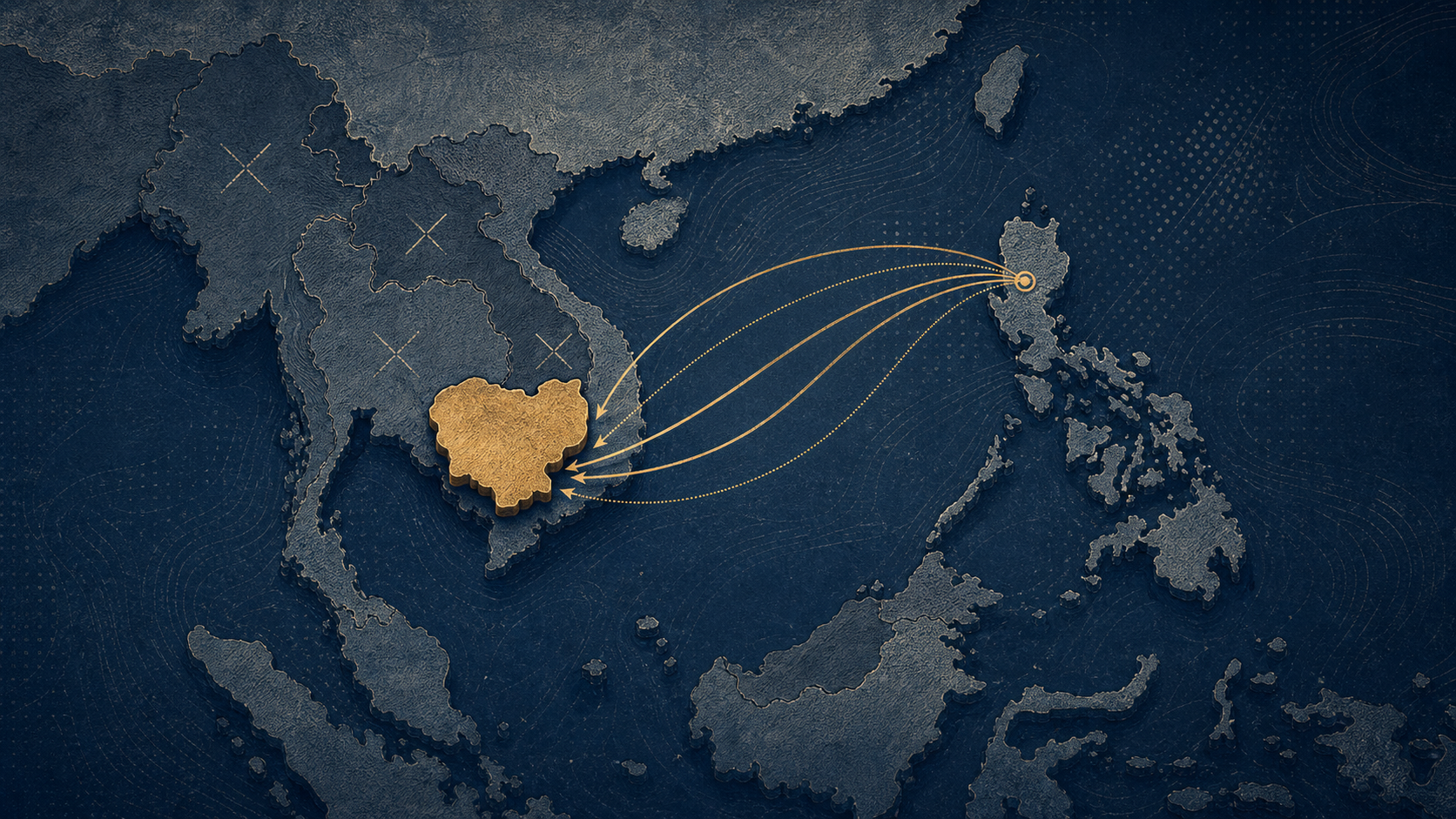
The Philippine offshore gaming operator industry did not die. It moved.
When President Ferdinand Marcos Jr. signed the executive order completing the POGO shutdown in late 2024, the regional gaming press described the announcement in finality terms — the end of an era, the closing of a chapter, a definitive break with the Duterte-era licensing model. But operators are not nation-states. Capital does not stop because a regulator says so. And the question that mattered, the one the Marcos administration had no policy answer for, was simply where the displaced businesses would go.
Eighteen months later, the answer is unambiguous. They went to Cambodia. Not all of them — some closed, some splintered into smaller Curacao-licensed shells, some retreated to opaque jurisdictions that do not publish licensee data. But the cluster that retained operational scale, technical infrastructure, and Chinese-language market access settled in one country. This is an analysis of why.
The structural answer
Three conditions had to be met simultaneously for any country to absorb the displaced POGO ecosystem. None of the alternatives could check all three boxes. Cambodia could.
The first condition was a legal framework that could host the work. Online gaming operators do not relocate on a handshake. They need a licensing authority, a published rulebook, a tax regime, and ideally a foreign-investment-friendly corporate vehicle. Most ASEAN gaming jurisdictions either prohibit online gaming outright or restrict it so tightly that relocation is impossible. Cambodia, almost uniquely, had passed its Law on Management of Integrated Resorts and Gaming in 2020, which created a structured pathway for online authorizations under the General Department of Gaming (later restructured as the GCG).
The second condition was physical infrastructure. Online gaming at scale is not a laptop business. It requires data centers, redundant network connectivity, residential capacity for several thousand staff, and a working immigration pathway for the predominantly Chinese-national workforce that the industry runs on. Building this infrastructure from scratch in a new jurisdiction takes years. Inheriting it — from a previous boom that had already built and then vacated the buildings — takes months. Sihanoukville, after the post-2019 collapse triggered by Cambodia's own ban on offshore-targeted online gambling, was exactly such a vacated boom-town.
The third condition was political tolerance. A jurisdiction can have the law and the buildings and still close the door. What Cambodia provided after the August 2023 transition to Prime Minister Hun Manet was an explicit signal that capital deployment in the gaming sector was welcome — particularly capital that brought back the construction, employment, and tax base that Sihanoukville had lost. The signal was not delivered as a single announcement. It was a year-long sequence of regulatory clarifications, expedited license processing, and senior-level meetings with industry representatives that collectively communicated the same message.
Why not Vietnam
Vietnam was the first jurisdiction the gaming press speculated about when the POGO ban became inevitable. The country has a long Chinese border, a tech-capable workforce, and a government that was, on paper, modernizing its approach to gaming. None of that translated into a viable destination.
Vietnam's gaming framework is structured around two pilot integrated resorts, both of which restrict casino access to foreign passport holders. There is no online gaming licensing authority. There is no published framework under which an operator could apply for an online authorization, and the Vietnamese state has shown no appetite for creating one. The country has, if anything, hardened its position against online gambling during the same window that Cambodia was softening — police actions against domestic online gambling rings increased markedly in 2024 and 2025.
For displaced POGO operators, this meant Vietnam was structurally closed. There was nothing to apply for, and even informal operation would have invited the kind of enforcement attention the operators had just spent two years trying to escape in the Philippines.
Why not Myanmar
Myanmar represented a different problem. The country does have an active gaming sector — concentrated in the lawless Karen and Shan state border zones, including the notorious "KK Park" compound that became internationally infamous in 2023 and 2024 for human trafficking and "pig butchering" scam operations.
But Myanmar's gaming sector is not a legal industry that legitimate operators can join. It is a security vacuum. Operating there means accepting that local armed groups, not a national regulator, govern the rules. It means dealing with rolling counter-trafficking operations by Thai and Chinese law enforcement that can sever telecom and electrical infrastructure on short notice. And it means accepting reputational contamination that no PAGCOR-era operator wanted on their corporate records.
For the better-capitalized POGO operators — the ones who had passed Philippine compliance reviews, even imperfectly, and who wanted a legitimate next chapter — Myanmar was unthinkable. The smaller, more compromised operators may have taken pieces of the Myanmar opportunity, but they did not represent the scale of capital that moved to Cambodia.
"We looked at four jurisdictions in detail. Cambodia was the only one where you could call the regulator's office, get a meeting, and walk out with an actionable timeline. That alone made the decision."
Former POGO operator, now relocated to Sihanoukville, speaking on background, January 2026Why not Laos
Laos had several elements working in its favor. The Bokeo Special Economic Zone — home to the Kings Romans casino complex — has hosted casino-adjacent online gaming for over a decade. The country has a small but functional gaming regulator. And Laos has historically been more tolerant of activity that other ASEAN jurisdictions would shut down.
But Laos has a scale problem. The country's total gaming workforce capacity, immigration processing throughput, and back-office infrastructure are an order of magnitude smaller than what the displaced POGO industry needed to absorb. Relocating one or two operators to Bokeo was possible. Relocating eighteen to twenty-two was not.
The country also carries its own reputational issues, particularly around the Kings Romans complex and its history of US Treasury sanctions on associated individuals. For operators trying to clean up their next chapter, those associations were a liability.
A small number of POGO operators did move to Laos. Industry estimates put the figure at perhaps three to five, mostly mid-tier firms with prior business relationships in the country. The remainder did not even attempt the move.
The Cambodian three-tier framework
By the time the Marcos administration was finalizing the POGO shutdown timeline, Cambodia had already published the regulatory architecture that would absorb the displacement. The framework, formalized through GCG implementing rules across 2024 and early 2025, structures gaming authorizations into three tiers. See our earlier news coverage of the framework launch for the operational details.
Tier 1 covers traditional land-based casino operations — the Sihanoukville beach resorts, the Bavet and Poipet border casinos, the urban Phnom Penh properties. This tier is the legacy heart of Cambodian gaming and predates the POGO question.
Tier 2 covers online gaming targeted at the Cambodian domestic market. This is a deliberately narrow authorization with capped operator count and stringent KYC requirements. It does not, as a practical matter, accommodate displaced POGO operators — the Cambodian domestic market is too small to host them.
Tier 3 is the one that matters. It authorizes online gaming operations targeted at international markets, hosted on Cambodian infrastructure but explicitly not solicited toward Cambodian residents. This is the direct analogue of the old PAGCOR POGO license. It is also the tier that nearly all displaced POGO operators have applied under.
The geopolitical bill
Hosting the displaced POGO industry is not a free trade. It comes with a bill, one that Cambodia is now in the process of paying.
The first cost is reputational. The same international scrutiny that Philippines POGOs attracted — on human trafficking, labor abuse, money laundering, and connections to scam operations — has begun to follow the displaced operators into Cambodia. International media coverage of "pig butchering" compounds, while geographically concentrated in Myanmar and parts of Laos, increasingly mentions Cambodia in the same breath. The country's previous decade of work to professionalize its gaming sector is being subtly undermined by the scale of the recent relocations.
The second cost is diplomatic. China, whose nationals constitute the dominant workforce in the displaced operations and whose citizens are also disproportionately the target market, has not been an enthusiastic observer of the Cambodian licensing strategy. Beijing has communicated, through standard diplomatic channels, that it expects active enforcement against operations targeting Chinese residents from foreign soil. How the Hun Manet government balances this expectation against the economic benefits of the gaming sector is one of the open questions of the next eighteen months.
The third cost is structural. Cambodia is, deliberately or not, becoming a destination jurisdiction in the global online gaming map. That status carries enforcement responsibilities, AML obligations under FATF guidelines, and the kind of regulatory scrutiny that small-state regulators are not always equipped to deliver. The GCG has been staffing up — substantially — but the gap between the institutional ambition and the institutional capacity is real.
What the Philippines lost, and what it didn't
The Marcos administration's framing of the POGO shutdown emphasized national security, law enforcement, and public morality. The policy succeeded on those terms, broadly. POGO-related human trafficking cases in Philippine courts have declined sharply. Manila's Bay City and Pasay City districts have visibly fewer POGO-linked storefronts. The kidnapping incidents that dominated 2022 and 2023 headlines have largely stopped.
But the policy did not succeed in shutting down the industry itself. It only relocated it. And the geopolitical question that the Philippines has not yet answered is whether a relocated POGO industry in Cambodia represents progress, indifference, or merely a shift in who bears the costs.
For the displaced operators, Cambodia is a holding position, not necessarily a permanent home. The same operators who relocated from the Philippines in 2024-2025 are watching jurisdictional developments in Curacao, the Isle of Man, and Malta. They are watching Thailand's integrated resort debate. They are watching whether the Trump administration's second-term China policy will affect the broader Asian online gaming ecosystem in ways that make Cambodia less viable.
What is unlikely to happen is a return to the Philippines. The PAGCOR PIGO framework — examined in detail in our regulatory maze analysis — is structurally domestic-facing, and the political cost of any administration reopening offshore licensing remains prohibitive. The displaced operators are gone. The question is just where they go next.
The bottom line
Cambodia did not win the POGO refugees by accident. It won them by being the only ASEAN jurisdiction that combined a published legal framework, available physical infrastructure, and political tolerance at the moment the Philippine shutdown forced the relocation. The other plausible destinations — Vietnam, Myanmar, Laos — each failed at least one of those three tests.
But absorbing the industry is not the same as solving the policy questions the industry raises. Cambodia inherited the operators. It also inherited their reputational baggage, their diplomatic complications, and their enforcement burden. Whether the country can manage all three simultaneously, while also continuing to develop as a legitimate Southeast Asian tourism and gaming destination, is the open question of the next decade.
The relocation is largely complete. The judgment on whether it was wise is still being written.
Frequently Asked Questions
Sources
- PAGCOR Exit Report on Closed POGO Operations, December 2024
- Cambodia Law on the Management of Integrated Resorts and Gaming (2020), as amended through 2024
- General Department of Gaming Cambodia (GCG) Implementing Rules, Tier 1 / Tier 2 / Tier 3 Frameworks
- Asia Gaming Brief, "Cambodia's Tier 3 licensing draws displaced POGO interest," March 2025
- IAG (Inside Asian Gaming), "Sihanoukville's second act," coverage 2024-2026
- Reuters Investigations, "The pig-butchering pipeline," series 2023-2025
- UN Office on Drugs and Crime, "Casino, money laundering, underground banking, and transnational organized crime in East and Southeast Asia," 2024
- Inquirer.net coverage of POGO shutdown timeline, 2024-2025
- Phnom Penh Post, "Hun Manet government signals gaming sector openness," 2024-2025 coverage